Full analysis of photovoltaic bracket industry knowledge in 2026
Complete analysis of photovoltaic mounting industry knowledge in 2026: technical logic, selection guidelines, and development trends
As the global clean energy transition continues to advance, the photovoltaic industry, as a core component of the new energy sector, has maintained steady growth in installed capacity in recent years. As the core supporting component of photovoltaic power stations, the performance of photovoltaic brackets directly affects the module's power generation efficiency, operating life, and full lifecycle operation and maintenance costs. Its technological iteration and solution optimization have also become key areas of focus for the industry chain. This article systematically reviews general technical knowledge, selection logic, and industry development trends for photovoltaic mounts in 2026, providing references for stakeholders in the industry.
1. Overview of Photovoltaic Mounting Systems
Photovoltaic brackets are special structural components designed to support, fix, and adjust the angle of photovoltaic modules. They are an indispensable component of the photovoltaic power station system, with their core functions mainly reflected in three aspects:
First, it improves power generation efficiency. Through reasonable tilt angles and orientation designs, photovoltaic modules maximize solar radiation. Some adjustable or tracked brackets can further match the sun's position changes, increasing sunlight reception duration and efficiency;
Second, to ensure operational safety, qualified photovoltaic supports can withstand natural environmental erosion such as daily wind, snow, heavy rain, and dust, and are designed for power stations of 25 years or more, avoiding losses such as module damage or station shutdowns caused by structural deformation, corrosion, and fractures;
Third, it reduces overall costs. Bracket solutions tailored to different scenarios can reduce investment in land leveling, foundation construction, and subsequent operation and maintenance, thereby improving the overall return on investment of photovoltaic power stations.
In terms of cost proportion, photovoltaic brackets account for about 8%-12% of the total cost of a photovoltaic power station system. Although the proportion is not large, it can impact the overall power generation revenue of the power station by more than 20%, making it a core component of the "low cost, high value" component in the photovoltaic system.
2. Mainstream classification and scenario adaptation
Currently, the mainstream photovoltaic mounting systems in the industry can be divided into three main categories: fixed mounts, tracking mounts, and flexible mounts. Each type has significant differences in structural characteristics, cost levels, and suitable scenarios:
(1) Fixed brackets
Fixed brackets refer to brackets with a post-inclination angle and orientation that remain fixed after installation, making them currently the most widely used bracket category in the industry. It has a simple structure, few components, low installation and maintenance difficulty, lower overall procurement and usage costs, and strong reliability. Fixed brackets can be further divided into pure fixed brackets and fixed adjustable brackets. Once installed, the tilt angle of pure fixed brackets cannot be adjusted, making them suitable for low-latitude areas with uniform lighting resources and minimal seasonal variation, as well as projects such as distributed rooftops and small ground-mounted power stations; Fixed adjustable brackets can manually adjust the tilt angle quarterly or semi-annually to suit regions with large seasonal lighting differences. Compared to pure fixed brackets, they can improve power generation efficiency by 5%-10%, with costs only about 10% higher than fixed brackets, offering obvious cost-performance advantages.
(2) Tracking bracket
A tracking mount refers to a type of bracket that can automatically adjust its angle according to changes in the sun's position, and can be further divided into single-axis and dual-axis tracking brackets. The single-axis tracking bracket only rotates along the horizontal azimuth axis to match the sun's azimuth changes, improving power generation efficiency by 10%-18% compared to fixed brackets; The dual-axis tracking mount can simultaneously adjust azimuth and height angles to maximize sunlight exposure, improving power generation efficiency by 18%-25% compared to fixed mounts. However, tracking brackets have complex structures and many components, with upfront procurement costs 30%-50% higher than fixed brackets, and are more difficult to operate and maintain. They are better suited for high-latitude areas with abundant sunlight resources and higher land costs, as well as centralized large bases and grid parity projects that require high power generation efficiency.
(3) Flexible Stents
Flexible supports use high-strength steel cables as the main load-bearing components, with photovoltaic modules suspended and fixed on the steel cables. Their core advantages are large spans and strong terrain adaptability. A single span can reach tens or even hundreds of meters, minimizing the need for terrain leveling, while ample space is reserved beneath the bracket. Flexible supports are adapted to complex terrains such as mountains, subsidence areas, and tidal flats, as well as scenarios requiring integrated land use like agrivoltaic and fishery-solar complementarity, enabling both "power generation and production" to be achieved, greatly enhancing land use value. However, flexible supports require higher cable strength and anchor point fixing, and their installation technology is more difficult than traditional rigid brackets. Their usage share is currently increasing year by year.
3. Material selection and core evaluation elements
The materials and anti-corrosion processes of photovoltaic mounts directly determine their lifespan and adaptability to different scenarios. Currently, mainstream materials and anti-corrosion solutions mainly fall into three categories:
(1) Hot-dip galvanized steel
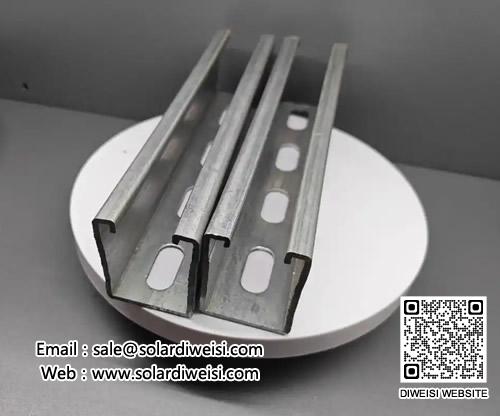
Hot-dip galvanizing is currently the most widely used anti-corrosion process. It refers to coating a layer of metallic zinc no less than 85μm thick on the surface of ordinary carbon steel, effectively isolating the steel from contact with the corrosive environment. The corrosion protection service can reach 20-25 years, with moderate cost. It is suitable for most photovoltaic projects in inland normal climates and is currently the mainstream material for fixed brackets.
(2) Aluminum alloys
Aluminum alloy is lightweight and naturally corrosion-resistant, able to adapt to high humidity and high salt spray corrosive environments without additional coating. Its strength is slightly lower than carbon steel, and its cost is 20%-30% higher than hot-dip galvanized steel. It is suitable for distributed roofs, coastal areas, and high-salinity lands, reducing roof load-bearing pressure and corrosion protection upgrade costs.
(3) Zinc-aluminum-magnesium alloy
Zinc-aluminum-magnesium is a new type of anti-corrosion coating material gradually promoted in recent years. The coating is composed of zinc, aluminum, magnesium, and a small amount of rare earth elements, featuring scratch self-repair properties. Its corrosion resistance is 2-3 times that of ordinary hot-dip galvanizing, and its corrosion resistance can last over 30 years. Although the cost is 10%-15% higher than conventional hot-dip galvanizing, it is suitable for heavily corrosive scenarios such as coastal areas, industrial zones, and saline-alkali lands, offering better cost performance throughout its entire lifecycle.
During the selection process, the following four core elements should be carefully considered:
(1) Terrain adaptability
Different projects have significant terrain conditions; for flat projects, priority should be given to lower-cost conventional fixed supports or tracking brackets; For mountainous and highly undulating complex terrains, adjustable supports suitable for different slopes and elevations should be chosen to reduce land leveling costs; For agricultural and fishery solar projects requiring composite land utilization, large-span flexible supports can be prioritized, with ample space reserved underneath.
(2) Rationality of load calculation
The load design of the supports must strictly comply with the relevant requirements of the "Photovoltaic Power Station Design Standard" (GB50797), and accurately calculate wind, snow, and self-weight loads based on historical meteorological data from the project location. In areas with frequent strong winds, the wind resistance design of the support structure should be optimized, and if necessary, inclined braces and thickened profile thickness should be added; In areas with heavy snowfall, the support tilt angle should be reasonably designed to allow space for snow to slide down and prevent deformation and fracture caused by snow overload.
(3) Corrosion resistance level matching
Supports should be selected according to the environmental corrosion level of the project location, corresponding to corrosion protection standards. For ordinary inland rural areas and urban areas, ordinary C3-grade anti-corrosion ordinary hot-dip galvanized steel can be chosen; In areas with high corrosion levels such as coastal areas, industrial zones, and saline-alkali land, zinc-aluminum-magnesium or aluminum alloy materials with C4 or above corrosion resistance grades should be selected to ensure the support supports meet the design requirements of the power station.
(4) Basic form adaptation
The selection of scaffolding foundations should be determined comprehensively based on terrain and geological conditions: in flat areas or areas with stable geological conditions, lower-cost concrete prefabricated foundations can be chosen; In mountainous and frozen soil areas, spiral pile foundations can be selected without pouring construction, with fast installation speed and recyclability; For fishery-solar complementary projects on tidal flats and soft soil foundations, prestressed pipe pile foundations can be chosen to improve foundation bearing capacity; Agri-solar complementary projects can choose ground anchor foundations, which cause minimal surface damage and do not affect crop planting below or the passage of agricultural machinery.
4. Market Trends and Technology Outlook for 2026
Entering 2026, with the continuous iteration of photovoltaic module technology and the continuous expansion of application scenarios, the photovoltaic mounting industry is showing four clear development trends:
(1) Adapting to large-size, high-power modules has become standard
Currently, large-size, high-power modules of 182mm and 210mm sizes have become mainstream in the market, with module power generally reaching 700W and above, and the module area and weight have significantly increased compared to traditional modules. To accommodate the application of large-size components, the bracket profile width, load capacity, and span design are being optimized simultaneously. At the same time, supporting components such as presses and bolts are being upgraded to prevent issues such as hidden cracks and deformation caused by uneven force on the module, ensuring operational reliability of large-size modules.
(2) Continuous improvement in the intelligence level of tracking mounts
The intelligent iteration of tracking mounts will become the core industry development direction in 2026. More and more tracking mount systems are equipped with AI algorithm modules, which can dynamically adjust the tracking angle by integrating real-time meteorological data, power station power generation data, and module shadow distribution, maximizing power generation efficiency. At the same time, the bracket system is equipped with sensors for vibration, tilt angle, corrosion level, and other factors, enabling real-time monitoring of operating status, predicting structural faults and corrosion risks in advance, and reducing later operation and maintenance costs; In extreme weather, the bracket can automatically adjust to the wind-avoiding tilt angle, reducing wind resistance and enhancing operational safety in extreme environments.
(3) The application scope of lightweight materials continues to expand
While ensuring structural strength, lightweight design of supports has become an industry consensus, with the proportion of lightweight materials such as high-strength low-alloy steel, high-performance aluminum alloys, and composite fiber materials increasing year by year. Lightweight supports can reduce labor costs during transportation and installation, while also lowering the requirements for foundation bearing capacity, suitable for more distributed projects with limited soft soil foundations and roof bearing capacity, further lowering the overall cost of photovoltaic systems.
(4) Increase in customized solutions for "PV+" composite scenarios
As the proportion of installed capacity in composite application scenarios such as agrivoltaic, agro-solar, and photovoltaic + desert control continues to rise, demand for customized mounting solutions adapted to different composite scenarios has grown significantly. For agrivoltaic complementary scenarios, the height and span design of the brackets can adapt to the planting needs of different crops and the requirements for agricultural machinery access; For fishery-light complementary scenarios, the anti-corrosion rating and basic form of the bracket can adapt to high humidity and high salt spray water environments; For photovoltaic + desert control scenarios, the brackets can reserve space for vegetation planting, achieving both power generation and ecological restoration goals.
Overall, as the core supporting components of photovoltaic systems, photovoltaic brackets are key directions for improving power station generation efficiency and reducing lifecycle costs. With the continued development of the photovoltaic industry, customized mounting solutions for different scenarios will keep emerging, supporting the large-scale promotion and application of clean energy.