Analysis of the application advantages of composite fasteners
Combined fasteners, consisting of integrated sets of bolts, nuts, washers, and other accessories, are commonly used connecting components in fields such as mechanical manufacturing, construction engineering, electromechanical equipment, and steel structure installation. Compared to the traditional method of purchasing individually and assembling piecemeal, combined fasteners offer significant advantages in terms of assembly efficiency, connection stability, construction cost, and adaptability, making them the mainstream choice for industrial assembly and engineering construction.
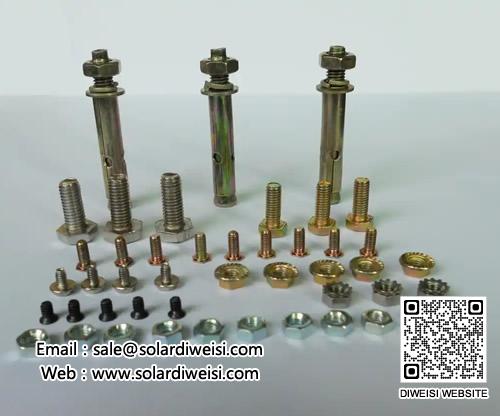
Combined fasteners firstly possess the prominent advantage of high assembly efficiency. The products have been pre-matched and matched at the factory, eliminating the need for workers to select specifications, match shims and nuts on site. They can be used directly after unpacking, saving the tedious process of manual sorting and model verification, significantly reducing on-site assembly time, and are suitable for mass production on assembly lines and centralized installation operations in large projects, effectively improving the overall construction progress.
Its core characteristic is stronger connection reliability. The combined fasteners undergo unified specification calibration, dimensional matching, and process treatment before leaving the factory, ensuring consistency in precision, hardness, and pressure-bearing performance of bolts, nuts, and washers. The supporting structure is evenly stressed, and the washers can disperse the pressure-bearing area, prevent loosening, and reduce vibration, avoiding issues such as loosening, eccentric loading, and slipping due to mismatched accessory specifications. They can maintain a tightened connection state for a long time, reducing safety hazards in equipment operation and engineering structures.
It brings significant benefits in cost control. The combination fasteners produced through batch standardization result in a more reasonable overall procurement cost, eliminating the need for separate procurement of various accessories, which can lead to price premiums. Additionally, it reduces on-site material waste and avoids parts being idled and overstocked due to mismatched specifications. The reduction in assembly labor hours indirectly lowers labor input, achieving comprehensive cost optimization throughout the entire process from procurement, warehousing to construction.
Warehousing and material management become more convenient. The integrated combination kit features uniform specifications and clear classification, eliminating the need for separate storage areas for bolts, nuts, and washers, thus saving storage space. The processes of material inventory and requisition registration are simplified, reducing the likelihood of missing parts and confusing models, effectively avoiding delays caused by incomplete materials and adapting to the standardized material management model of enterprises.
It has a wide range of applicable scenarios and excellent durability. The combination fasteners have undergone surface treatments such as galvanizing and rust prevention, providing good corrosion resistance, rust resistance, and weather resistance, making them suitable for complex working conditions such as outdoor exposure, wet chemical environments, and high-temperature machinery. The standardized specifications have strong universality, meeting the connection needs of various industries such as steel structures, mechanical equipment, municipal facilities, and rail transit, with outstanding universality and interchangeability.
In addition, the combined structure comes with anti-loosening and shock-absorbing effects. The washers can buffer the external force impact caused by vibration, reduce the probability of bolt loosening, decrease the frequency of later maintenance and repair, and extend the service life of equipment and structures.
In summary, composite fasteners, with their multiple advantages such as ease of assembly, stable connection, controllable cost, simple management, and strong adaptability, meet the development needs of modern industrial production and engineering construction standardization, and possess extensive application value and promotion prospects.